Why are we changing the citizenship application process?
Last night I watched a video from VideoParliament Ireland of TD, Paul Lawless of Aontú, calling for tighter rules on citizenship. The video starts with him talking about Riad Bouchaker, the sick man who brutally and senselessly attacked a group of young children in Parnell Square on November 23, 2023. Earlier this year he was found guilty of the attempted murder of three children, one of whom has sustained long-term life-altering injuries. He was also convicted of assault causing serious harm to crèche worker Leanne Flynn, who courageously put herself in harm’s way to protect the children.
A young teenager who also intervened sustained injuries. It was a horrific crime. A French trainee chef attempted to grab the attacker’s knife. While a Brazilian man, Caio Benicio, who was on his motorbike making Deliveroo runs, pulled over, took off his motorcycle helmet, and used it to strike Bouchaker over the head with immense force, successfully disarming and subduing him.
Not that it changes anything, but that young girl who was left seriously disabled by the attack, her parents are immigrants, one from another EU state and one from farther afield.
But Mr Lawless didn’t mention the ethnicities of the victims or the heroes of that day, instead he focused on how Riad Bouchaker, who was originally from Algeria and lived in Ireland for 20 years or more, has Irish citizenship. How could this man get citizenship when he hadn’t worked a day in his life and didn’t speak enough English to attend trial without an interpreter?
You may think this is a fair question. But let’s really think about it for a minute.
I want you to consider the hundreds of thousands of migrants that have come to Ireland in the 20 or more years that Bouchaker has lived here. The majority of them do work and speak English as well as you or I. But some may have come here to be with a spouse or following a family member. Riad Bouchaker moved to Ireland because his brother had moved here. Imagine for a minute a man who moves here because his brother has moved to Ireland is singing its praises. It’s the place to be. The man who moves here is awkward and really only interacts with his brother. He finds it difficult to get work. But he is in good health and he is a kind and empathetic man. Basically imagine a Riad Bouchaker who would never ever commit the senseless and depraved crime that the real Bouchaker did. Would you have a problem with that awkward, inarticulate man being granted Irish citizenship? Why?
Should unemployed people be denied Irish citizenship? Should we insist that people applying for Irish citizenship should be able to understand legal proceedings in English? Should we insist that they are fluent in a language which isn’t even the first language of this country? Should we insist that they are fluent in Irish, when most Irish people, myself included, only have the cúpla focal?
What are the eligibility requirements currently for applying for Irish citizenship?
The application looks at the length of your reckonable residence, your work history, your character (there is Garda vetting and you need 3 character references from Irish citizens), and your ties to the country, maybe through family who legally reside here, or involvement with professional associations or community organisations. Reckonable residence is basically permission to work or reside here for reasons other than study or awaiting the decision on a residence/asylum application, or some temporary residence permission.
At the moment, standard applications need 5 years of reckonable residence out of the last 9 years, including 1 continuous year right before your application, meaning you cannot be absent from Ireland for more than 70 days during the 12 months immediately before your application.
The Proposed Changes
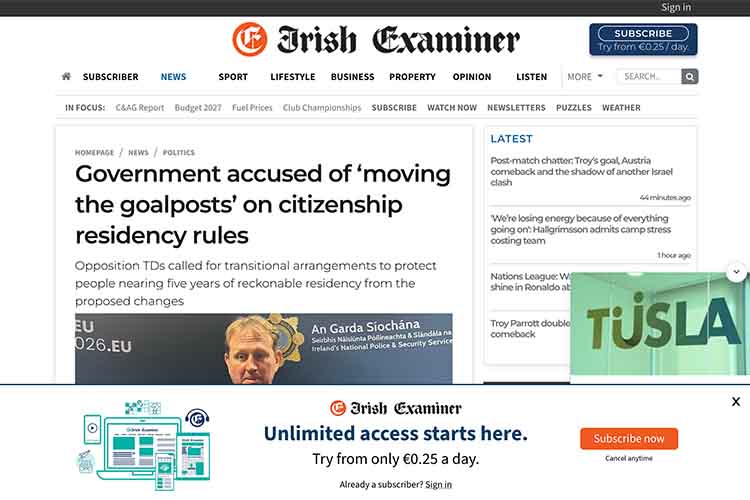
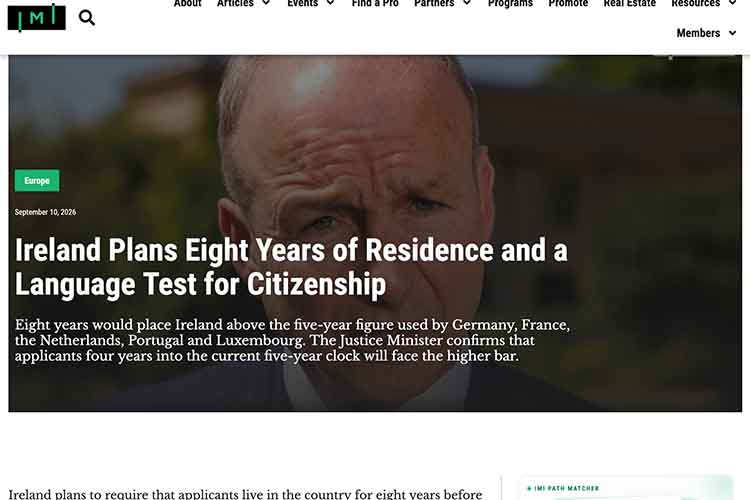
Our government recently gave the green light to prioritize the drafting of the Irish Nationality and Citizenship (Amendment) Bill 2026. Minister for Justice Jim O’Callaghan said the new rules would bring us “in line with Europe”, whatever that means. Under the new plans, the minimum reckonable residence required to apply for naturalization will increase from five years to eight years, including 2 continuous years of residence immediately prior to application. Candidates will also have to take English, Irish, or Irish Sign Language proficiency tests, as well as a new civics and history exam.
Perhaps the civics and history exam will be similar to the Life in the UK test. Why not take a mock test of that? - Was it a little bit trickier than you thought it would be? Do you wonder if the average British person might find some of the those questions hard to answer? Do I think if we had a similar test in Ireland the average Irish person might find it difficult to know the right answers? I do. Maybe I’m wrong on that. But if I’m not, are you really happy with a citizenship test that the average citizen wouldn’t easily pass?
By the way if you’re British and reading this thinking I’m anti-British or anti-English, I’m not at all. I love so much of English culture. Many of my favourite authors, musicians, movies, tv-shows are all English. So please don’t take anything I’m saying that way. But I do think Britain has let anti-migrant sentiment gather pace — which has been very much to its detriment. And over the last 10 years I’ve seen a similar rise in racism in Ireland. It’s awful — it’s everything I thought we were not — and I want to stand against it.
Obviously most British people, most English people, are not racist. It’s a multi-cultural society. And it’s a very safe country — there has been some crazy reporting online making out that London is “unsafe”. It’s nuts. Don’t fall for it.
So why are we changing the citizenship application process?
What happened that made our government think this was such a priority? Did we conduct research that showed there would be a benefit to our economy or to the migrants themselves if we added in a few more hurdles into the citizenship application process? Do we have data that shows the real problems in this country are due to people getting Irish citizenship who are not proficient in English, Irish or Irish Sign Language? Is the reason why we have a housing crisis that not enough immigrants are sufficiently familiar with Irish Civics and History? Is this why electricity and gas are so expensive? Is it because some immigrants might not know what it means when someone from Northern Ireland calls them a Free Stater?
Am I being a little facetious? Yes, I am. But isn’t that better than pandering to the rising anti-migrant element within the electorate? Which seems to me to be the only reasonable explanation for these changes.
Speaking of Northern Ireland
I think the reason for my slightly facetious tone is because I looked at a couple of mock Life in the UK tests. One of the questions was In what year did Ireland split into two countries? To which I, as an Irish person, replied out loud, What do you mean two countries? It’s always been one country, with 6 counties still under British rule. Am I correct in saying that? Factually? Perhaps not. Perhaps so. But then the question goes deeper than facts — which may not care about your feelings but most definitely care about who ever is in power and defines them.
Let’s talk about Parades…
This week a stand-off occurred on the Garvaghy Road in Drumcree between the Orange Order, who wanted to march down the road, and local residents who feel that these marches are essentially expressions of domination and control. The Orange Order are a loyal (to the British Crown) Protestant order who hold parades and marches in remembrance of William of Orange’s defeat of King James II at the Battle of Boyne in 1690. The Orange Order feels it’s their right to celebrate and commenorate this victory.
It may sound like a minor altercation but the history of conflicts over marches and their consequences is tragic. I’m not going to rake up anything. It’s sad — it resulted in assaults and murders. If you want the whole history, here’s a link.
28 years ago a Parades Commission was set up to mediate and decide which parades were allowed and which weren’t. For 28 years no marches were allowed down the Garvaghy Road, and then this year the Commission agreed to a small Orange Order march down the road at an early hour of the morning. The parade was first refused as usual but the Portadown Orange Order said that procedural rules weren’t followed and challenged the refusal in the High Court which agreed and handed down a scathing judgment. So the Parades Commission had to reassess the application. And that’s how the Parades Commission agreed to an Orange Order march down the Garvaghy Road under tight restrictions — but without the residents’ consent.
The Orange Order intended to have the parade, including the march down the Garvaghy Road, on Sunday, September 27th. The residents protested and refused to allow the march. As of today, October 1st, the stand-off continues.
The reason I mention it is because of a comment I saw on a youtube video about the standoff. I didn’t keep a note of the video (I think it was a short) but the comment has relevance here. There has been an odd alliance between the anti-migrant crowd here in the Republic and anti-migrant loyalists in Northern Ireland. It’s so odd. The anti-migrant crowd here, who like to call anyone who isn’t xenophobic a traitor, have an alliance of sorts with anti-migrant people in Northern Ireland who are loyal to the British Crown and have zero loyalty or respect for the Republic. It’s truly weird… The comment I saw was from someone with an Irish name suggesting that this standoff was occurring because pro-migrant types were determined to create a rift between the anti-migrant groups throughout the island.
It wasn’t phrased like that exactly, but that was the gist. An anti-migrant conspiracy theorist who believes that the reason some Loyalists want to march triumphantly down a predominantly Catholic neighbourhood is because pro-migrant forces want to drive a wedge between racist loyalists and racist nationalists. Brilliant.
If you can’t see how anti-migrant Irish people in Republic who want to say “We decide who is Irish, we control this place, WE are who owns this country” are so very similar to Orange Order men who want to march through neighbourhoods without residents consent because it’s part of their proud history, then I don’t think you can tell up from down or night from day.
So Minister, why are you changing the application process for Irish citizenship?
How does it improve anything? What savings does it bring in? What does it do other than tell immigrants, the people who come here to work, to build a better life, that we’re just not sure we want them? Can they jump through a few more hurdles please?
If there is a substantive policy objective behind these changes, please explain what it is and outline the evidence that supports it.
Without this explanation, I find it very hard to see these changes as anything other than pandering to racists.
Is anyone with me on this?
I really do feel like I’m on a different planet these days. I feel very disconnected. Do the majority of people in Ireland agree with me on this? I’ve absolutely no idea. Do you agree? Are you in Ireland? Are you a registered voter? If not, please go register. And if you agree with what I’ve said in this post, please sign this Uplift petition to keep the rules as they are.